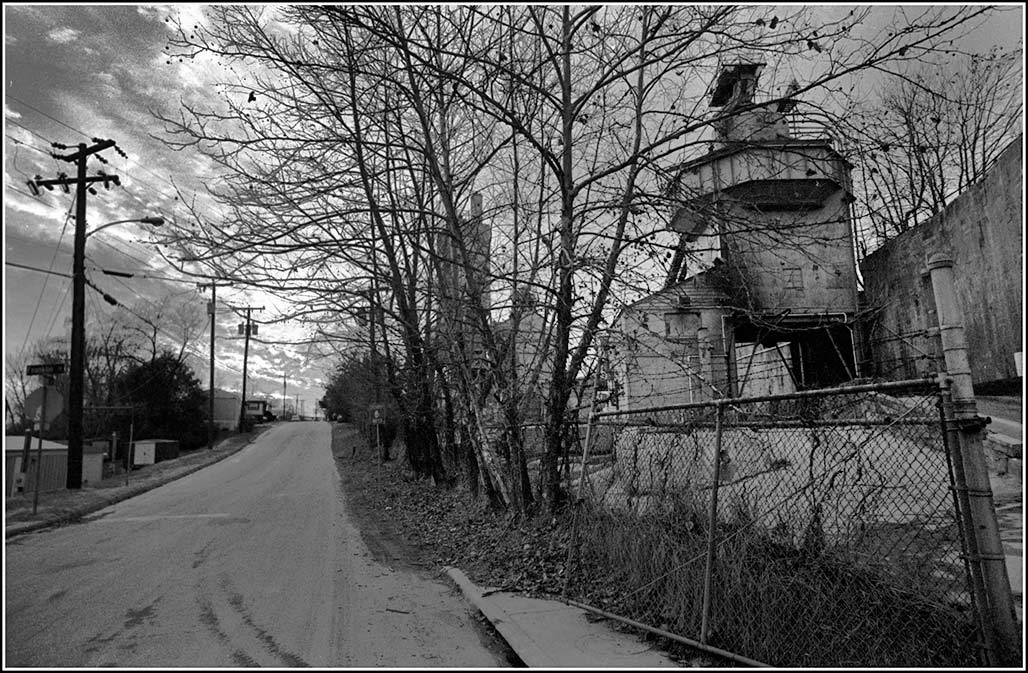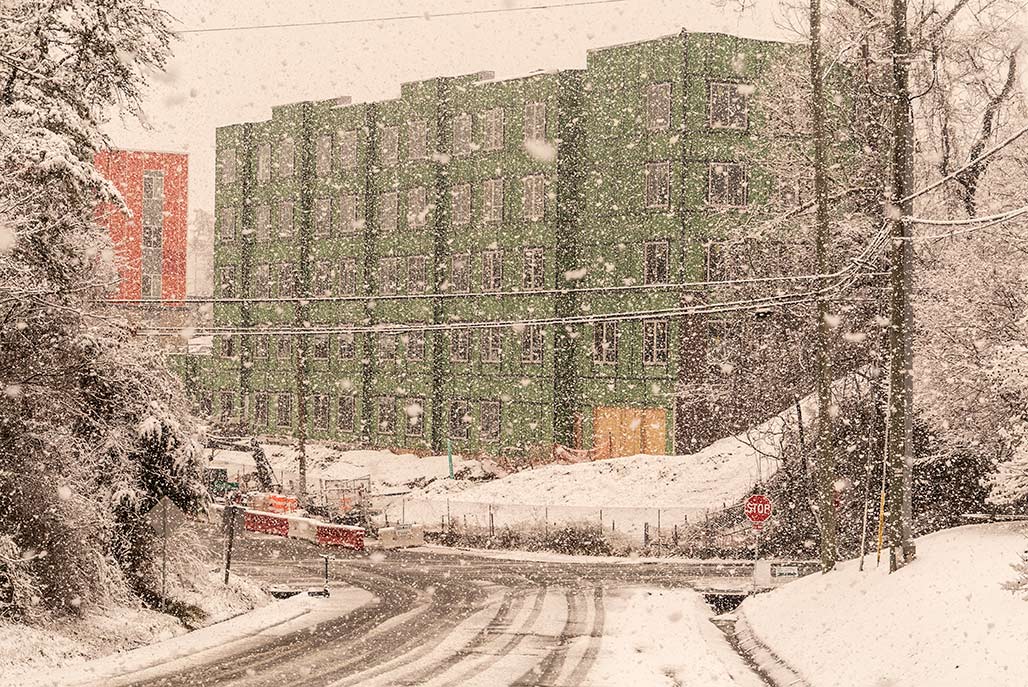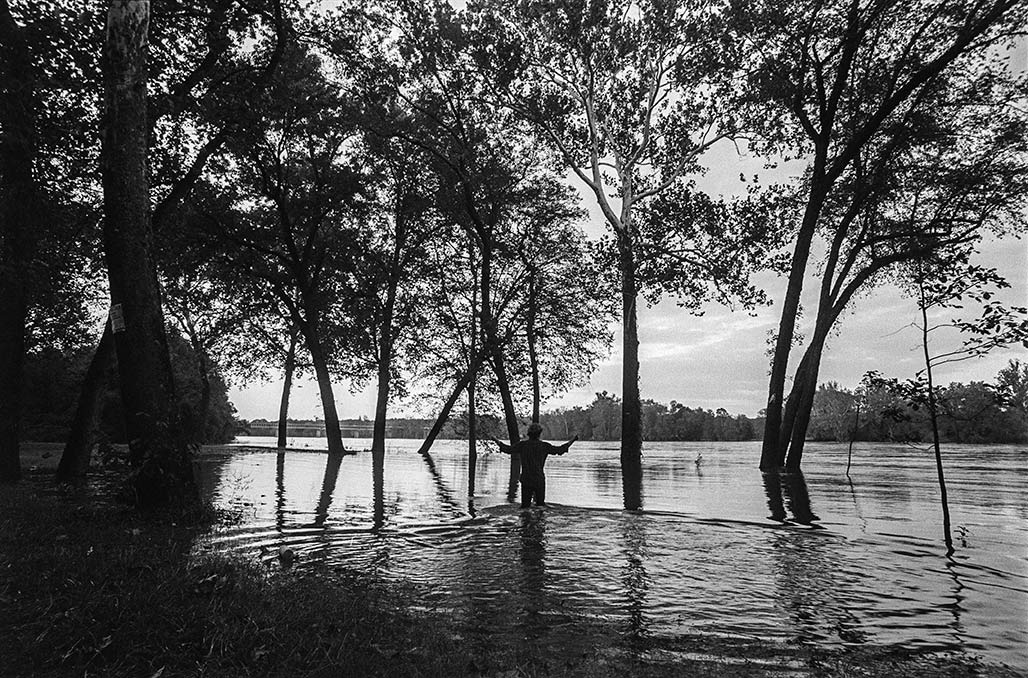
floodplain fill

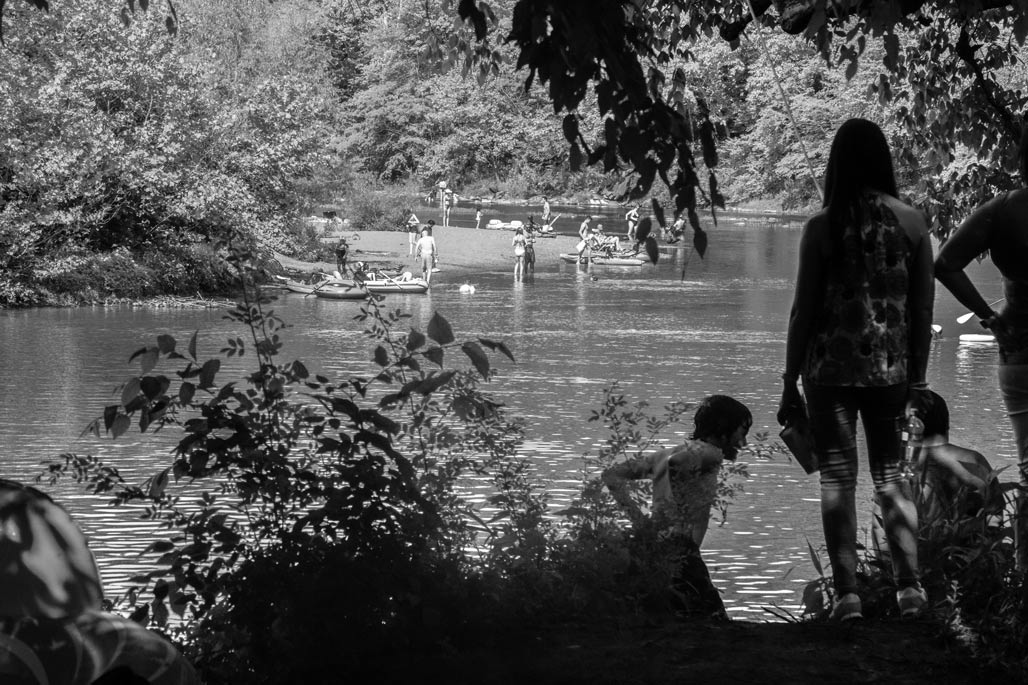
James River floodplain south of Hugenot Bridge

I would like to throw in a different thought than what we’ve been talking about. So we’ve been talking all evening about storm water volume and flows and base flood elevations and floodway fringes and floodplains and 100 year floods and 500 year floods. And I’m well familiar with all these terms, because I spent more than 30 years running a national stream and wetland habitat restoration program across the entire United States, but I also spent over a decade surveying the biological integrity of Moores Creek. So I’m really familiar with this.

I was also vice president of the Belmont Neighborhood Association. I lived there for many years. So I know that neighborhood really well. I know the county side really well. So we’ll just establish that, but we haven’t talked about the other purposes that a floodplain provides.

It is not simply a zone where water is stored during a high water event. It does serve to dissipate the energy of flood waters. Yes, you do want them to be able to spread out and slow down, because they’re less erosive than if you push them into a funnel and let them go really fast, and that’s why we don’t like filling in the floodplain, because it constricts that flow and makes it go fast.

So we can accept the engineers analysis that they say that because this is a backwater fill situation where the water, as the Rivanna River, rises, it backs up Moores Creek, but that they have done all their calculations to say that this small area fill will not raise the base flood elevation. Fine, I’m not going to argue with that.

All right. I’m not an engineer, although I do work with a lot of engineers, but we haven’t talked about the fact that there’s other things that go on in the floodplain that are also really important.
This is habitat. This is not simply an exercise in water flow, but it is also a habitat where many different species depend on that riverine habitat.
Riverine is not a word that we’ve heard tonight that refers to that unique habitat that exists along the river. And those of you who canoe or hike or spend a lot of time in the water understand that that is a different environment than the upland environment.

So to quote the Department of Wildlife Resources, Moores Creek, which flows to the city of Charlottesville, is a tributary to the Rivanna. For decades, urbanization and manipulation have degraded the habitat and water quality of Moores Creek. And it goes on and talks about the potential for Moores Creek to be restored, and notes that multiple species of greatest conservation need listed in Virginia’s wildlife action plan could potentially live in Moores creek or the Rivanna river, and they go on to list all the different species.

Just because we have urbanized the watershed doesn’t mean we should continue to degrade it, just because we thought it was a good idea decades ago that we would put industrial uses along a river that that’s still a great idea.

Zoning can be old and stale and a bad idea, and so the underlying zone here is a bad idea, and I understand that that’s not what’s before us tonight. What’s before us is, can we let them fill in the floodplain?
So there’s a reason why the Comprehensive Plan listed this as parks and green systems. It’s because it’s a flood plain, right? That is why, and the floodplain isn’t just about floods, as I said. So I would like to mention some of the other stakeholders who are not here tonight to testify. And I’m going to save you me rattling off hundreds of species and put you in a coma. I’ll just list a few, the great blue heron, the little green heron, the salamander, the kingfisher or the red bellied woodpecker. I could go on and on with a list of aquatic and riparian species that depend on that habitat. And when we fill it and we destroy it, we diminish that.
So you might say, well, this is just a small area. We’re just going to destroy that small area, because you will destroy it when you fill it and put industrial uses on top of it. But my mom used to use this phrase. You’ve probably heard, death by 1000 paper cuts. That’s what’s wrong with Moores Creek, that’s what’s wrong with the Rivanna river. And so I don’t want to continue to do bad things just because FEMA says, If we pile a bunch of dirt tall and high enough, we’ll be outside the floodplain.
We can engineer just about anything. And I’m going to give you a quick example, I promise quick, that will help you understand the fallacy of this type of thinking.
Let’s just talk about what you can do regulatorily. We could pipe all the creeks. We could get permits from the Army Corps of Engineers. We could pipe our creeks, we could put dirt on top of them, and then, guess what? We won’t have floodplains. Then we could develop on top of all of the prior creek areas, because we could have more industrial use.

Isn’t that great?

No, it’s not great, because rivers and riparian systems provide so many other benefits, habitat areas of respite, quiet, solitude, and habitat for species that, frankly, don’t survive and thrive in other places. And so it’s up to you, if you want to take the attitude that with good engineering and enough bulldozers, we can make it work, and we can meet the federal regulations, but we’re not hitting the spirit of the law, which is to try to protect the aquatic resources of our state. So I’m just, I’m going to leave it there.
I’m opposed to this application. I’m opposed to all filling of floodplains for that reason. And there’s a reason why the Comprehensive Plan said this should be parks and green systems, and I’m sticking with the Comprehensive Plan. I’ll leave it there. I’ll only talk again, if there’s some technical thing that I want to object to, but that’s where I stand. Thank you.–Commissioner Karen Firehock December 16, 2025, Albemarle County Planning Commission meeting

Albemarle BOS will vote the fill up or down January 14, 2026. There is a petition asking them to deny this application to fill, please consider weighing in.

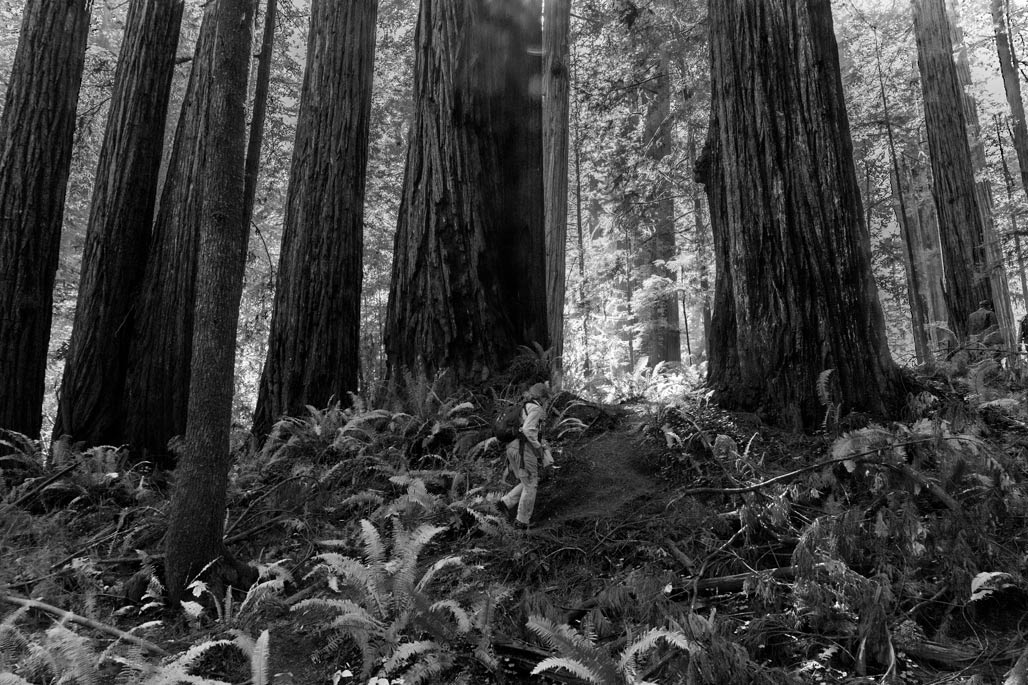
Monacan Bulldozer

Bulldozer in the foreground, Monticello in the background, floodplain in between.

There’s lots of things that we can do with engineering, with big machines and modern equipment. I mean, there are lots of things that one could do.
And so we do have the ability to build up the soil and help create an island, an elevation that will then put a structure that is out of the 100 year floodplain. That’s true.
We also could pipe the creek and pave it over and then we wouldn’t have to have a buffer. You could actually get a permit from the Army Corps of Engineers to do things like that.

But should we?

That’s where I’m coming from. The 100 year floodplain has a very important hydrologic function in allowing, during a storm, as a water is rushing down, because it has this area it spreads out and dissipates the energy of the water and then some of that sediment load actually drops out in that slower water at the margins. That’s why floodplain soils are so rich, that’s why people like to farm them, because it’s some of the best soil, because that’s where those floodwaters dissipate and lose their energy.
When you constrict the area that the water is flowing through it goes faster. So on a large scale, looking at the whole area, I understand what Mr. Pohl is saying and I understand what Timmons has said, that this will not raise the elevation of the flood overall.

But I’m also looking at this from two perspectives; one is death by 1000 paper cuts, which is all the little fills cumulatively altogether, I don’t have the confidence that we’re looking at it from that perspective.
The other aspect is, again, what I just said about floodplains. They have a purpose and we really should not build in the floodplains. Albemarle County is actually more restrictive; we don’t let you put subdivisions in the floodplains.

You know, our neighbors in Charlottesville allowed a development of housing in the floodplain through an area which I used to kayak when the water was up.
And too bad for those folks when we get another big storm.
I believe very strongly and I have a 35 year career in floodplain and watershed management, and so I’ve spent my whole life trying to keep people out of floodplains.

I would also suggest to you that the zoning, yes is from 1997. But in our comp plan, never mind the park thing for a moment to my commissioner at the other end of the dais, they’re not suggesting this become a park necessarily, but it’s designated as green system because the county did go along and say all of these floodplains, we’re going to call them green systems.

Don’t always think of the Earth as just a place where we are going to recreate or not recreate. There are other ecological functions that are going on there for biota, for salamanders, for all kinds of other critters that are also under our stewardship.
Where I’m coming from is I’m not in favor of allowing fill in the floodplain.

I think that zoning can be old, zoning can be wrong. Zoning can be a bad idea. I think this zoning is outdated. I agree with Lonnie. There are a lot of a lot of reasons why we developed along rivers, that was because that was a transportation system. We had to move goods on the Rivanna. We put goods on batteaux on the Rivanna and sent them down to Richmond. So you know, there’s a lot of reasons why people develop near rivers, also for water supply.

But today, putting industrial along our rivers is also a bad idea. So I don’t think the zoning is good. We’re not here tonight to decide about the zoning, we are here to decide whether you think it’s OK to fill in the floodplain. And I’m going to stick with the comprehensive plan. I think it was wise to say that this is a green system and I don’t care if no one ever recreates in it. So that’s where I’m coming.

I have a lot of hydrologic reasons and ecological reasons for the way that I am presenting my position tonight. I don’t think we’re getting a huge return for allowing this site to become this industrial use by getting it out of the floodplain. That’s it.
I will now step down off my soapbox and yield to my colleagues.–Karen Firehock April 22, 2025 Albemarle County Planning Commission

Earth Day

plant a tree today.

This afternoon the Albemarle County Planning Commission will discuss SP202400026, a request to grade and fill in the floodplain. Those interested in the physical and cultural landscape of central Virginia, consider attending the meeting and providing feedback.
https://albemarle-org.zoom.us/j/81459650960
Webinar ID: 814 5965 0960
1-312-626-6799
1-877-853-5247 (Toll Free)
Press # to enter the meeting without a Participant ID.
Webinar ID: 814 5965 0960

McMansion

I’ve heard about these things.

McMansion
noun
Mc· Man· sion mək-ˈman(t)-shən
A very large house built in usually a suburban neighborhood or development
especially : one regarded critically as oversized and ostentatious
“12900 Aden Rd is a 6,476 square foot house on a 10 acre lot with 4 bedrooms and 5 bathrooms.. Based on Redfin’s Nokesville data, we estimate the home’s value is $1,303,606.”


stony prominence

power plant
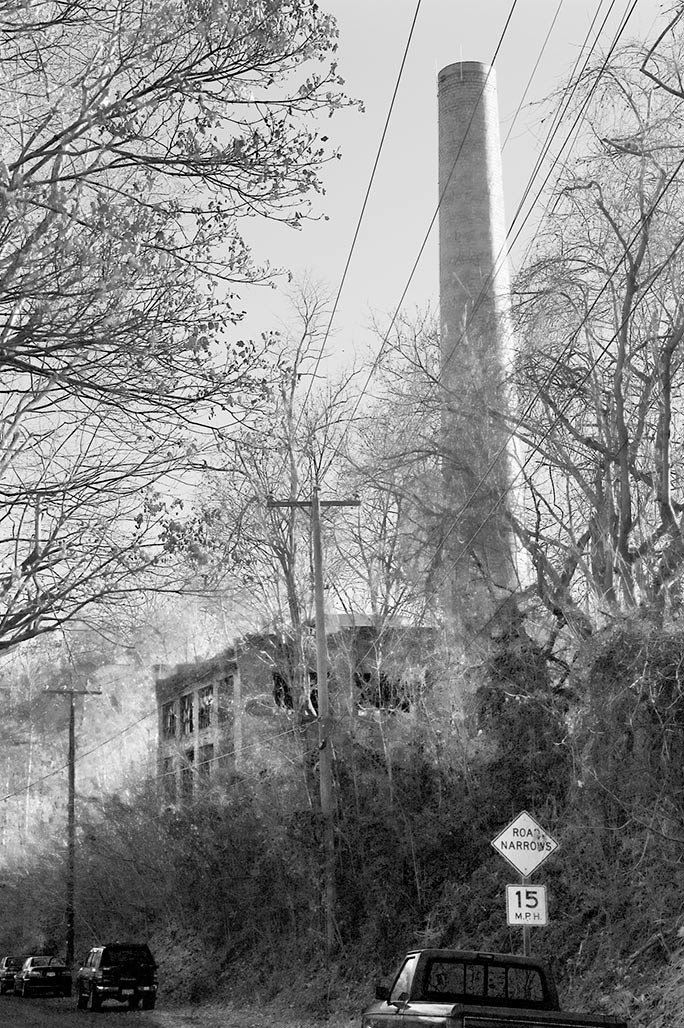
The story of Charlottesville’s most famous mill complex is also the tale of a section of Albemarle County, specifically the plot of land approximately one mile east of Charlottesville’s original downtown. “At that point,” wrote Harry E. Poindexter, “Moore’s Creek empties into the [Rivanna] river from the southwest, forming a narrow triangle of land which rises rapidly to a rocky crest some one hundred feet high.”– Britton

3. Community Meeting – ZMA 202200013 Power Plant Residences
PROJECT: ZMA202200013 Power Plant Residences
MAGISTERIAL DISTRICT: Scottsville
TAX MAP/PARCEL(S): 07800-00-00-021B1
LOCATION: South side of E. Market Street, approximately 60 linear feet southeast of the municipal boundary between the City of Charlottesville and Albemarle County, VA
PETITION: Rezone 0.61 acres of Preserved Steep Slopes Overlay Zoning District to Managed Steep Slopes Overlay District on TMP 07800-00-00-021B1. No changes to the underlying primary R4 Zoning District are proposed with this application.

5th & Avon Community Advisory Committee

Date: 05/18/2023 7:00 PM – 8:30 PM
Location: 5th Street County Office Building, Room B
1600 5th Street Ext
Charlottesville, Virginia 22902

Application materials available

Eminent Domain

3 dogs
I asked Council to seize 21 acres in the floodplain of the Rivanna River, to provide the current owner of the property with just compensation, and create another river park. In the alternative there will be a 15 foot flood wall that blocks access from neighborhoods to the river, a 2 acre parking lot and 245 apartment units.

“that sort of burst on us about a week ago”

(audio from 3 of 5 councilors below.)

Cville Plans Together

west view Carlton Avenue 2003
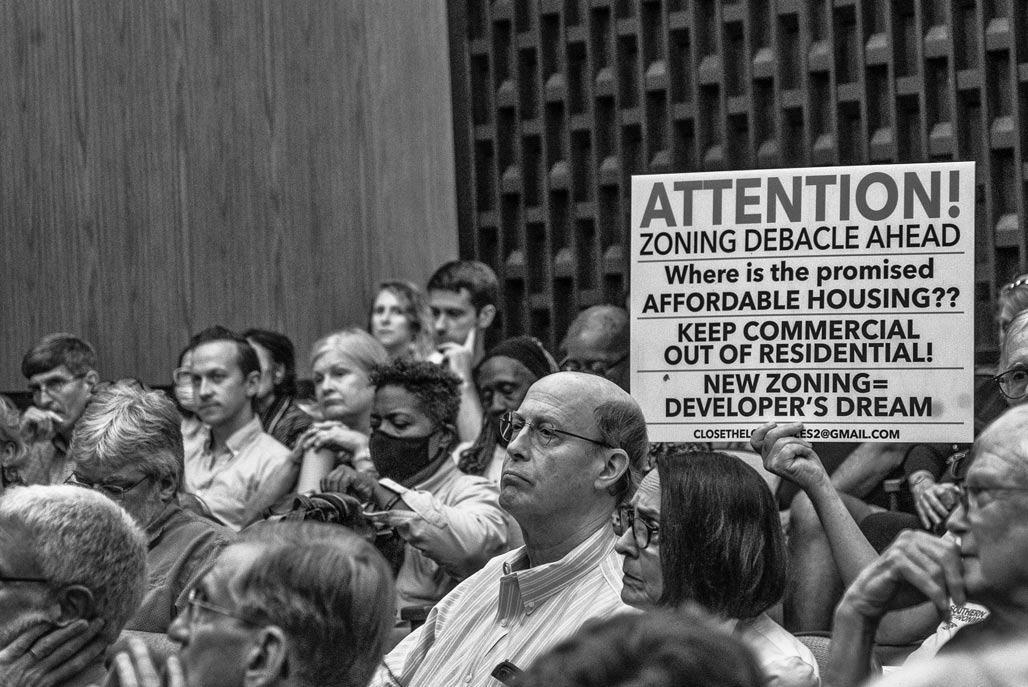
March 1 City Council endorsed the affordable housing plan, the lead piece of the three part Cville Plans Together effort. The three easy pieces, the housing plan, a rewritten “Comprehensive” plan and a rewritten zoning ordinance. Who will make the money from this effort? Who will loose?
Carlton Views III under construction
The 4.86 acre H.T.Ferron plant, once zoned for manufacturing, is now zoned for PUD. No one agrees what PUD is. That is what is so wonderful about PUD. You see what you want to see. Possibly we’ll rezone the entire city PUD?