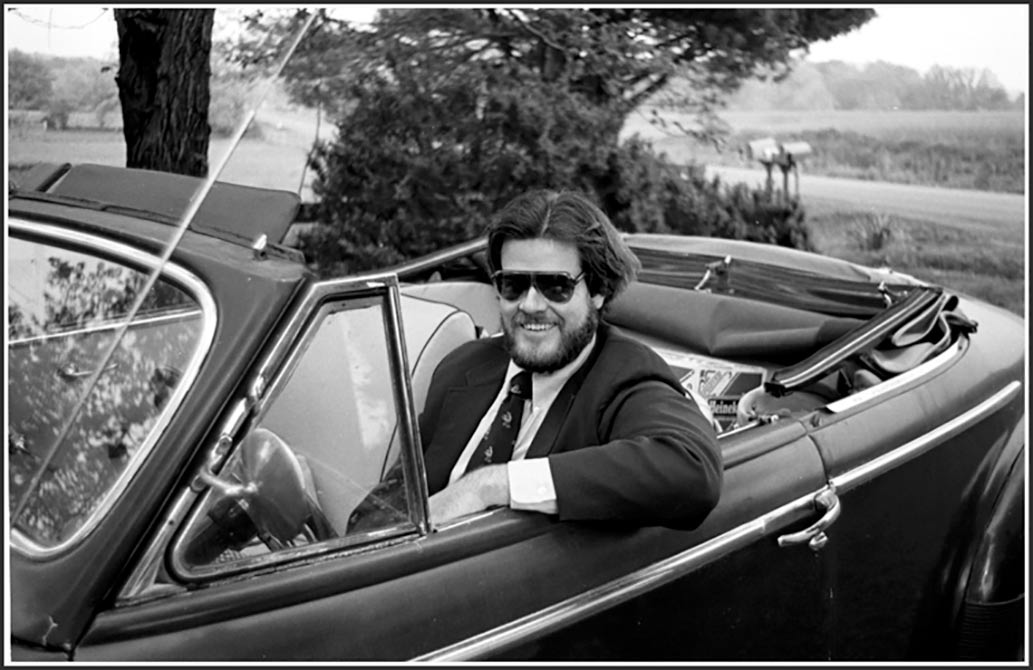
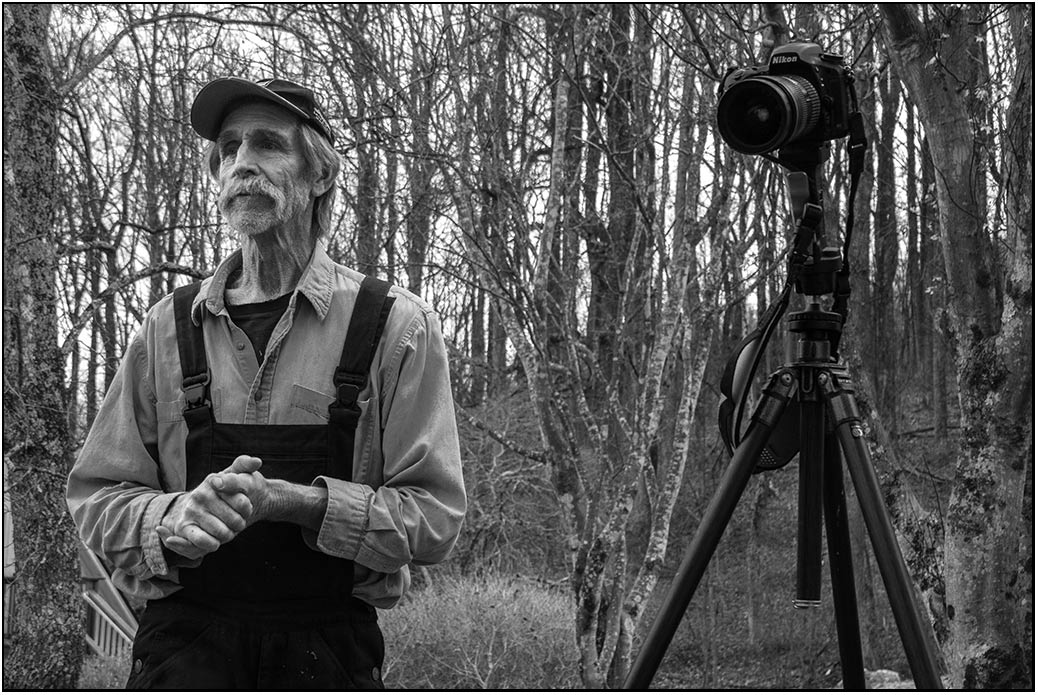
My name is “Henry Watkins (‘Henry’ or ‘Wat’) Ellerson, III,” and I died on May 3, 2026. I tried really hard to stop aging, but it did not work. I was a former lawyer, auctioneer, certified barbecue judge, certified auto mechanic, certified advanced open-water SCUBA diver, Boy Scout aquatic merit-badge counselor, inventor, musician, stand-up comedian, particle-physics dabbler, raconteur, curmudgeon, rabble-rouser, rabid civil libertarian, “liberal” gun owner, Goldwater supporter, Trump hater, secular inhumanist, atheist freethinker, and Certified Hyper-Critic, late of Hadensville, Virginia. I lived and practiced law in Orange, Virginia for 25 years, and I served as a “Special Justice” there, hearing petitions for involuntary mental health treatment. When people asked how I got that job, I told them “It takes one to know one.”
I was born in the first wave of Baby-Boomers on August 19, 1946 in Roanoke Rapids, North Carolina and was educated in the public schools there. I was the son of Frances Thompson Ellerson Watts and H. Watkins Ellerson, Jr., both of whom predeceased me along with my sister, Elizabeth Bryan Ellerson Pasco. I was also predeceased by my step-father, James O. Watts, Jr. and my step-brother, James O. Watts, III. Amazingly, I graduated from Randolph-Macon College, Washington & Lee University Law School, and the auto mechanic’s program at J. Sargeant Reynolds Community College. (I only wanted to be a car mechanic in high school.)
I also completed a course in Creative Writing at University of Virginia, completed the summer Mediation Workshop at Harvard Law School, and I studied computer machine-code programming at Germanna Community College. I also taught Real Estate Law there as an adjunct. I was certified by Virginia Tech for both Planning Commissions and Boards of Zoning Appeals. I p***ed a lot of money away as a principal in the eponymous “EllerSoul Records,” producing and distributing blues music albums.
I am survived by many cousins and by my brother, James P. Ellerson and his wife, Lorraine, my nieces Margaret Lindsey Goebel (and her two children) of Annapolis, Maryland and Frances Page Ellerson, of Brooklyn, New York, my nephew, William Watkins Pasco, a step-nephew, Samuel Pasco, a step-brother, Stephen Watts, a step-sister, Key Watts Giles, a brother-in-law, John Pasco, III and a sister-in-law, Mary Pasco, all of Richmond, Virginia.
I really enjoyed cheap cars, fast likker and hard wimmin. I wasted a lot of time in college and law school listening to my favorite recordings instead of studying. I was an aficionado of the twisted humor of “The Firesign Theatre” and movie director John Waters, as well as the “music” of Root Boy Slim. I came to appreciate and somewhat understand artificial intelligence (“AI”) and particle physics, as well as theoretical mathematics, focusing on the fascinating relationship between the “Golden Mean” and the “Fibonacci Series.” Way back in the early 1970’s, The Firesign Theatre summed up particle physics perfectly with the title to their “(Groucho) Marx & (John) Lennon” album: “How Can You Be In Two Places At Once When You’re Not Anywhere At All?” I was a long-time subscriber to MAD Magazine and was an avid reader of horror comics, especially the 3-D kind, with special glasses. I also subscribed for several years to Science Weekly, The Nation, the National Review and the National Lampoon.
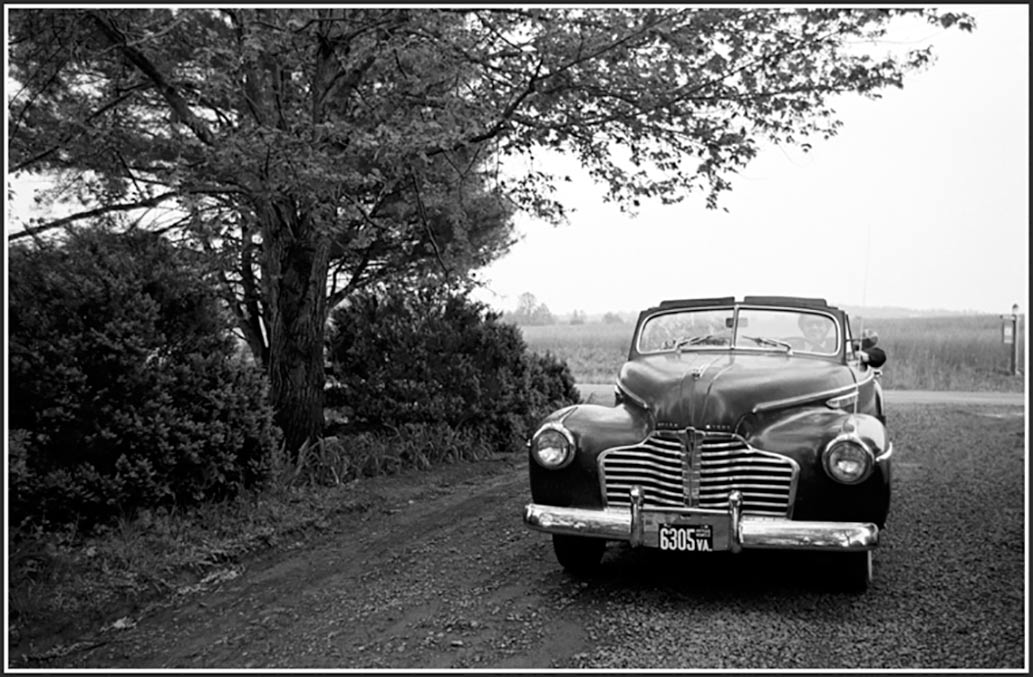
I had many fun “escapades” with motor vehicles. Long after a terrifying night plowing through a soybean field in NC with my “father’s Oldsmobile,” and after a further period away at boarding school in Va., I was informed by my father one evening at the dinner table (where I usually paid dear prices for my “entertainments”) that said Oldsmobile had been “chewing” up tires, so he had taken it to a repair shop. My father was beckoned back into the shop area to look at the underside of his car on a lift. There were dead weeds, dirt and a bent tie rod thereunder. The service manager asked my father, “By any chance do you have a teen-aged son?” It was difficult to maintain a “puzzled” look on my face upon hearing that story!
the floodplains shall be filled, the mountain and hill shall be made low: the crooked shall be made straight, and the rough places smooth.
Albemarle County Supervisors vote 4-2 to further terraform at the base of Monticello mountain.
Mallek and Missel voted to prevent harm in the flood hazard overlay district and to retain the benefits of ecosystem services provided by Albemarle’s green and riverine systems to inhabitants of the County and City.
Duncan, Gallaway, LaPisto-Kirtley and Pruitt voted with the civil engineers to acquire four metal buildings, impervious surface and tax revenue.
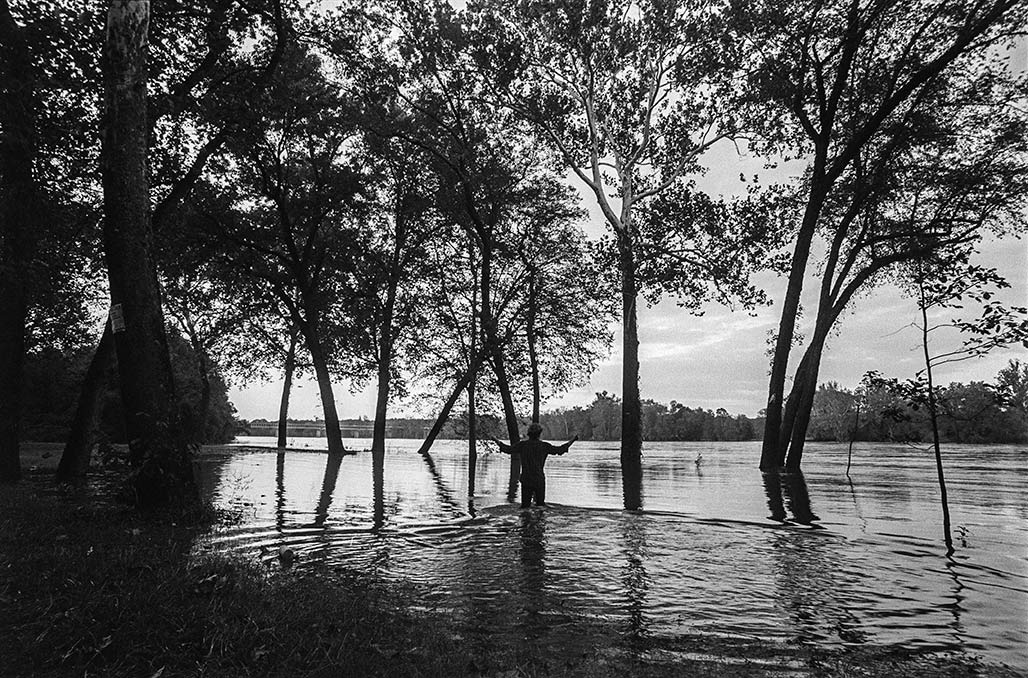
James River floodplain south of Hugenot Bridge
I would like to throw in a different thought than what we’ve been talking about. So we’ve been talking all evening about storm water volume and flows and base flood elevations and floodway fringes and floodplains and 100 year floods and 500 year floods. And I’m well familiar with all these terms, because I spent more than 30 years running a national stream and wetland habitat restoration program across the entire United States, but I also spent over a decade surveying the biological integrity of Moores Creek. So I’m really familiar with this.
I was also vice president of the Belmont Neighborhood Association. I lived there for many years. So I know that neighborhood really well. I know the county side really well. So we’ll just establish that, but we haven’t talked about the other purposes that a floodplain provides.
It is not simply a zone where water is stored during a high water event. It does serve to dissipate the energy of flood waters. Yes, you do want them to be able to spread out and slow down, because they’re less erosive than if you push them into a funnel and let them go really fast, and that’s why we don’t like filling in the floodplain, because it constricts that flow and makes it go fast.
So we can accept the engineers analysis that they say that because this is a backwater fill situation where the water, as the Rivanna River, rises, it backs up Moores Creek, but that they have done all their calculations to say that this small area fill will not raise the base flood elevation. Fine, I’m not going to argue with that.
All right. I’m not an engineer, although I do work with a lot of engineers, but we haven’t talked about the fact that there’s other things that go on in the floodplain that are also really important.
This is habitat. This is not simply an exercise in water flow, but it is also a habitat where many different species depend on that riverine habitat.
Riverine is not a word that we’ve heard tonight that refers to that unique habitat that exists along the river. And those of you who canoe or hike or spend a lot of time in the water understand that that is a different environment than the upland environment.
So to quote the Department of Wildlife Resources, Moores Creek, which flows to the city of Charlottesville, is a tributary to the Rivanna. For decades, urbanization and manipulation have degraded the habitat and water quality of Moores Creek. And it goes on and talks about the potential for Moores Creek to be restored, and notes that multiple species of greatest conservation need listed in Virginia’s wildlife action plan could potentially live in Moores creek or the Rivanna river, and they go on to list all the different species.
Just because we have urbanized the watershed doesn’t mean we should continue to degrade it, just because we thought it was a good idea decades ago that we would put industrial uses along a river that that’s still a great idea.
Zoning can be old and stale and a bad idea, and so the underlying zone here is a bad idea, and I understand that that’s not what’s before us tonight. What’s before us is, can we let them fill in the floodplain?
So there’s a reason why the Comprehensive Plan listed this as parks and green systems. It’s because it’s a flood plain, right? That is why, and the floodplain isn’t just about floods, as I said. So I would like to mention some of the other stakeholders who are not here tonight to testify. And I’m going to save you me rattling off hundreds of species and put you in a coma. I’ll just list a few, the great blue heron, the little green heron, the salamander, the kingfisher or the red bellied woodpecker. I could go on and on with a list of aquatic and riparian species that depend on that habitat. And when we fill it and we destroy it, we diminish that.
So you might say, well, this is just a small area. We’re just going to destroy that small area, because you will destroy it when you fill it and put industrial uses on top of it. But my mom used to use this phrase. You’ve probably heard, death by 1000 paper cuts. That’s what’s wrong with Moores Creek, that’s what’s wrong with the Rivanna river. And so I don’t want to continue to do bad things just because FEMA says, If we pile a bunch of dirt tall and high enough, we’ll be outside the floodplain.
We can engineer just about anything. And I’m going to give you a quick example, I promise quick, that will help you understand the fallacy of this type of thinking.
Let’s just talk about what you can do regulatorily. We could pipe all the creeks. We could get permits from the Army Corps of Engineers. We could pipe our creeks, we could put dirt on top of them, and then, guess what? We won’t have floodplains. Then we could develop on top of all of the prior creek areas, because we could have more industrial use.
Isn’t that great?
No, it’s not great, because rivers and riparian systems provide so many other benefits, habitat areas of respite, quiet, solitude, and habitat for species that, frankly, don’t survive and thrive in other places. And so it’s up to you, if you want to take the attitude that with good engineering and enough bulldozers, we can make it work, and we can meet the federal regulations, but we’re not hitting the spirit of the law, which is to try to protect the aquatic resources of our state. So I’m just, I’m going to leave it there.
I’m opposed to this application. I’m opposed to all filling of floodplains for that reason. And there’s a reason why the Comprehensive Plan said this should be parks and green systems, and I’m sticking with the Comprehensive Plan. I’ll leave it there. I’ll only talk again, if there’s some technical thing that I want to object to, but that’s where I stand. Thank you.–Commissioner Karen Firehock December 16, 2025, Albemarle County Planning Commission meeting
Albemarle BOS will vote the fill up or down January 14, 2026. There is a petition asking them to deny this application to fill, please consider weighing in.
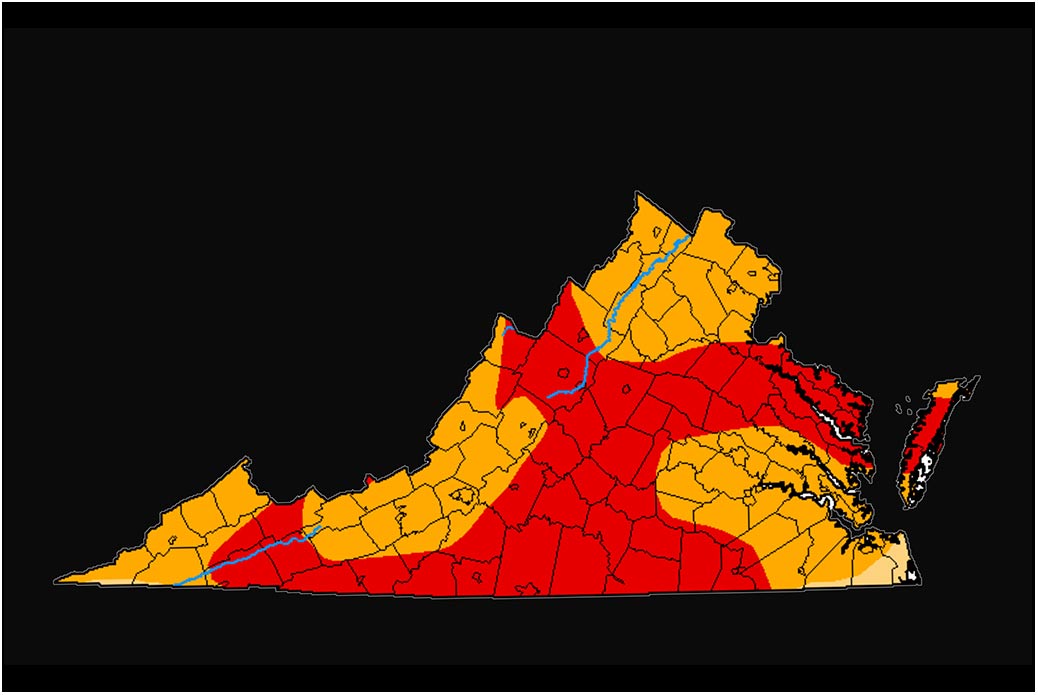 Its been a dry spring in Virginia. Limited April showers have resulted in challenging conditions for plants. I’ve been drip irrigating juveniles in CHO. In the Tidewater there is a group of a few hundred adolescent trees I look after.
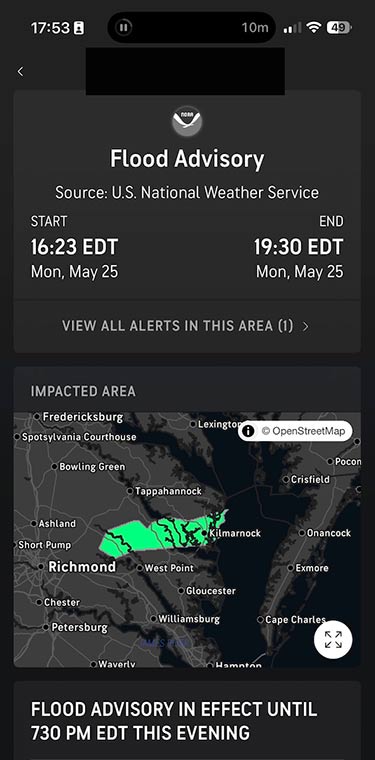 Rain began falling at 1430 hours
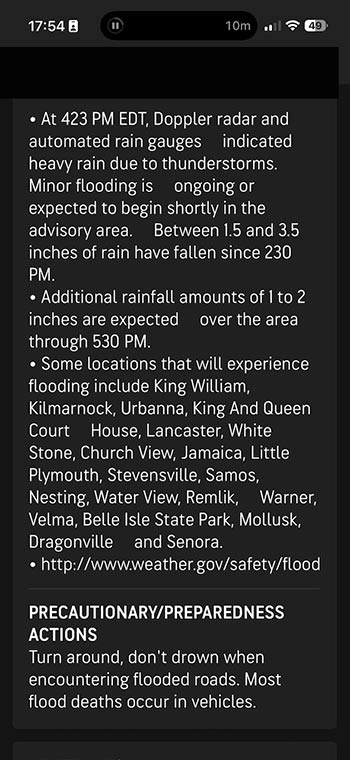 Between 1430 and 1830 six inches of rain came down.
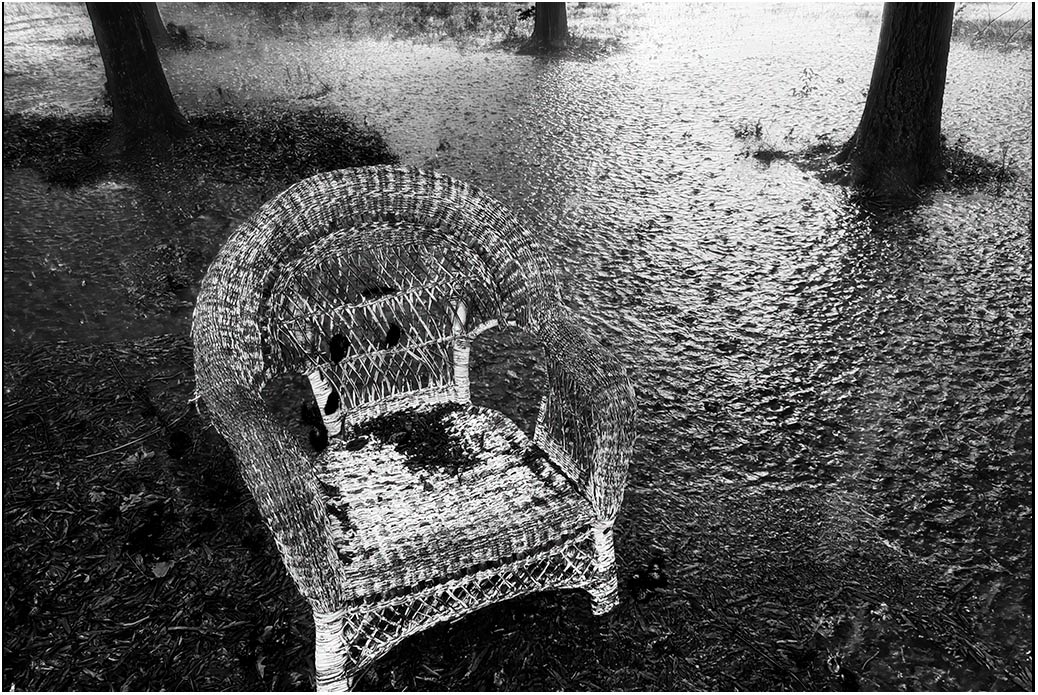 It’s pretty flat in Slabtown.
 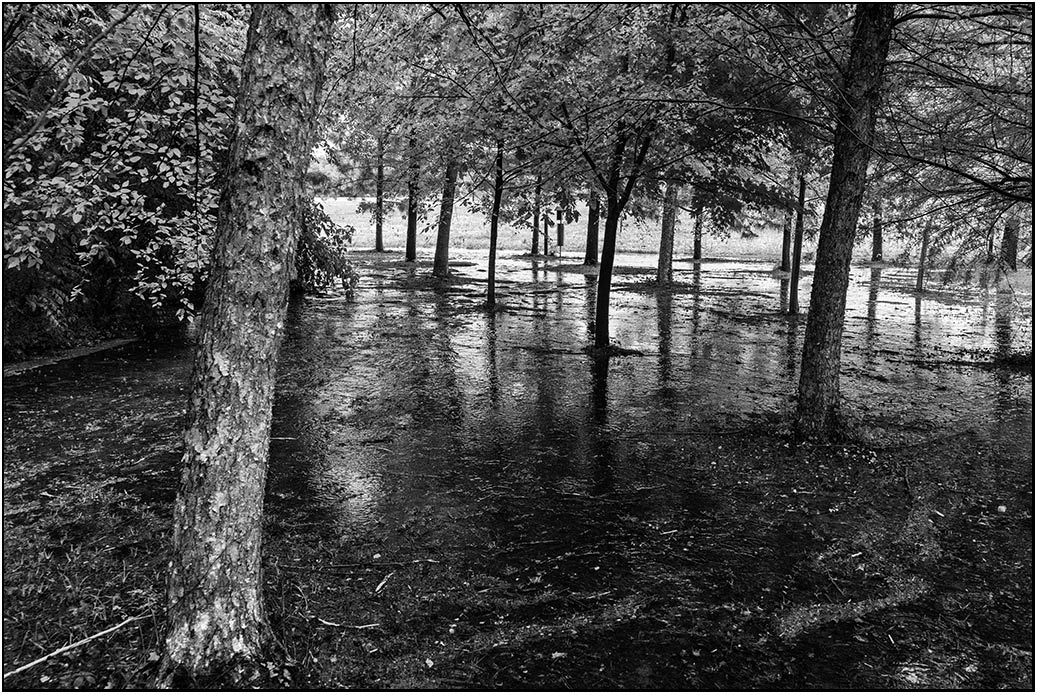 takes awhile to soak in
 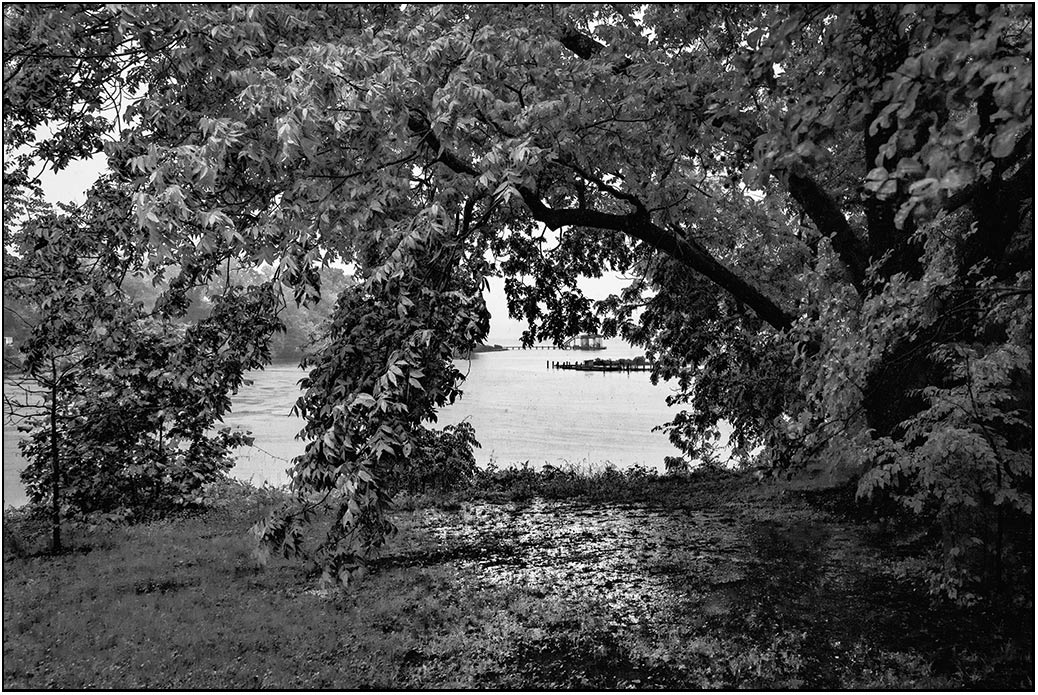 sheet flow in the yard
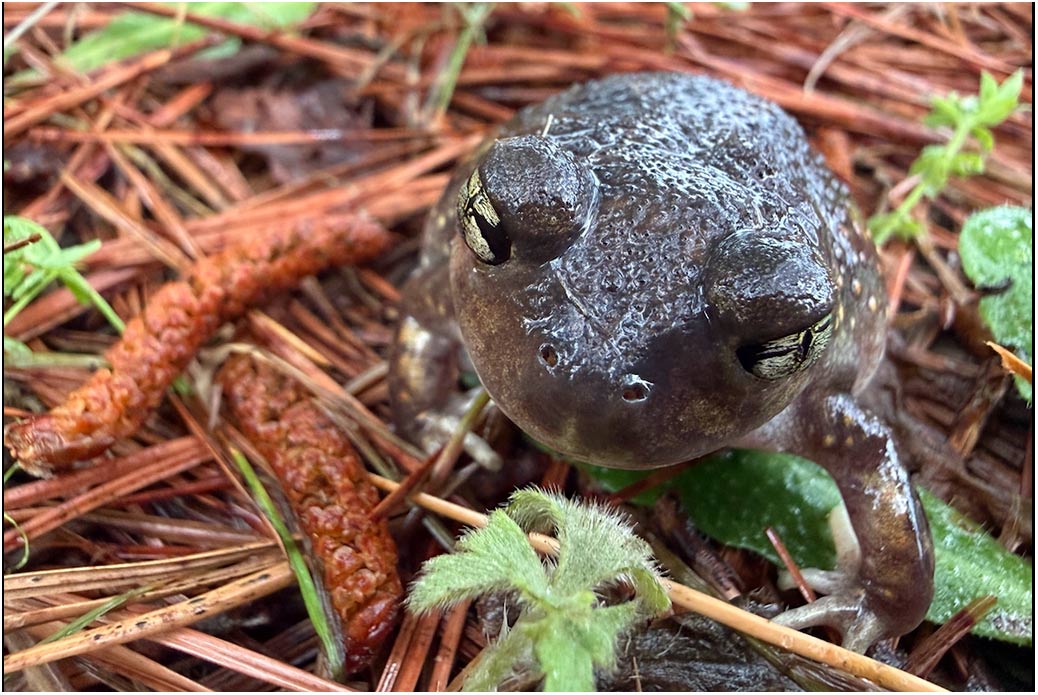 all things wet and wonderful